Beast of the West: How Victor Wembanyama and the Spurs Just Shattered OKC’s Playoff Illusion

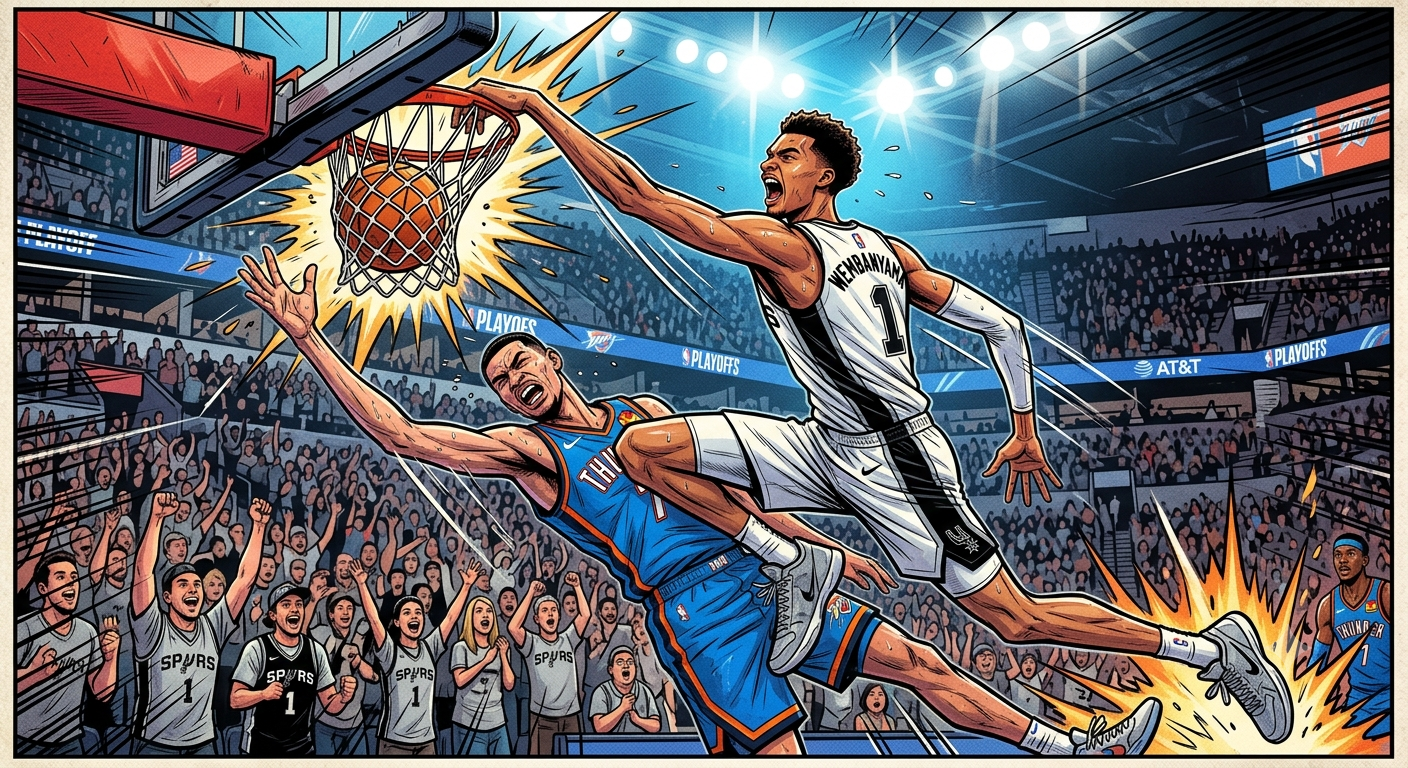
Comic-book style illustration of Victor Wembanyama throwing down a powerful dunk over a defender in the 2026 NBA playoffs.

Wemby’s First or SGA’s 2nd?

In my opinion, this series is the true NBA final because either the Spurs or OKC will beat the Knicks or the Cavs

If anyone thought the Oklahoma City Thunder were just going to cruise their way to an NBA Finals appearance, Victor Wembanyama just gave the entire league a 7-foot-4 reality check.

In a grueling, double-overtime Game 1 thriller, the San Antonio Spurs did what nobody else could manage in the first two rounds of these 2026 playoffs: they made the Thunder bleed. Oklahoma City rolled into the Western Conference Finals completely untamed, sweeping through their first two series with flawless, undefeated momentum. They looked unstoppable. But they hadn’t run into the sheer willpower of a generational monster. By the time the final buzzer rang on a 122-115 statement win for San Antonio, OKC’s perfect postseason record was dead and buried.

A Performance for the Ages. Let’s talk about the numbers, because what Victor Wembanyama just pulled off defies belief.

Wemby clocked over 49 minutes on the floor—the heaviest workload of his young career—and put up a staggering 41 points, 24 rebounds, and 3 blocks. At just 22 years old, he officially became the youngest player in NBA history to drop a 40-20 game in the postseason.

SGA and the Thunder’s Resilience Make no mistake—Oklahoma City didn’t just fold. Shai Gilgeous-Alexander played like the MVP candidate he is, answering every single Spurs run with absolute composure. SGA’s ability to get to his spots and collapse the defense is what dragged this game into double overtime in the first place. But even a masterclass from Shai wasn’t enough to overcome the historic interior wall San Antonio built in those final five minutes.

When the game dragged into deep water, the reigning Defensive Player of the Year simply refused to fade. After a clutch, ice-cold three-pointer in the first overtime kept the Spurs alive, Wemby completely broke the game open in the second extra period. He capped off his historic night by slamming home an and-one dunk right over Chet Holmgren, effectively shutting the door on the Thunder’s home court.

Mindset Over Momentum. What makes this win so significant isn’t just the tactical adjustments; it’s the psychological shift. The Thunder have been playing like an elite machine, but the Spurs brought a grit and a “survival mode” mentality that OKC wasn’t prepared to handle.

As Wembanyama noted post-game, it came down to sheer willpower. When you drag a top-ranked offense into a double-overtime fistfight, momentum goes out the window. It becomes about who wants to answer the call when their lungs are burning.

The Spurs stole home-court advantage in spectacular fashion, and while this is bound to be a long, brutal series, one thing is now undeniable: San Antonio knows exactly how to break the unbreakable.
The Bloodline’s Newest Beast: Why Jacob Fatu is the Real Deal for Roman Reigns

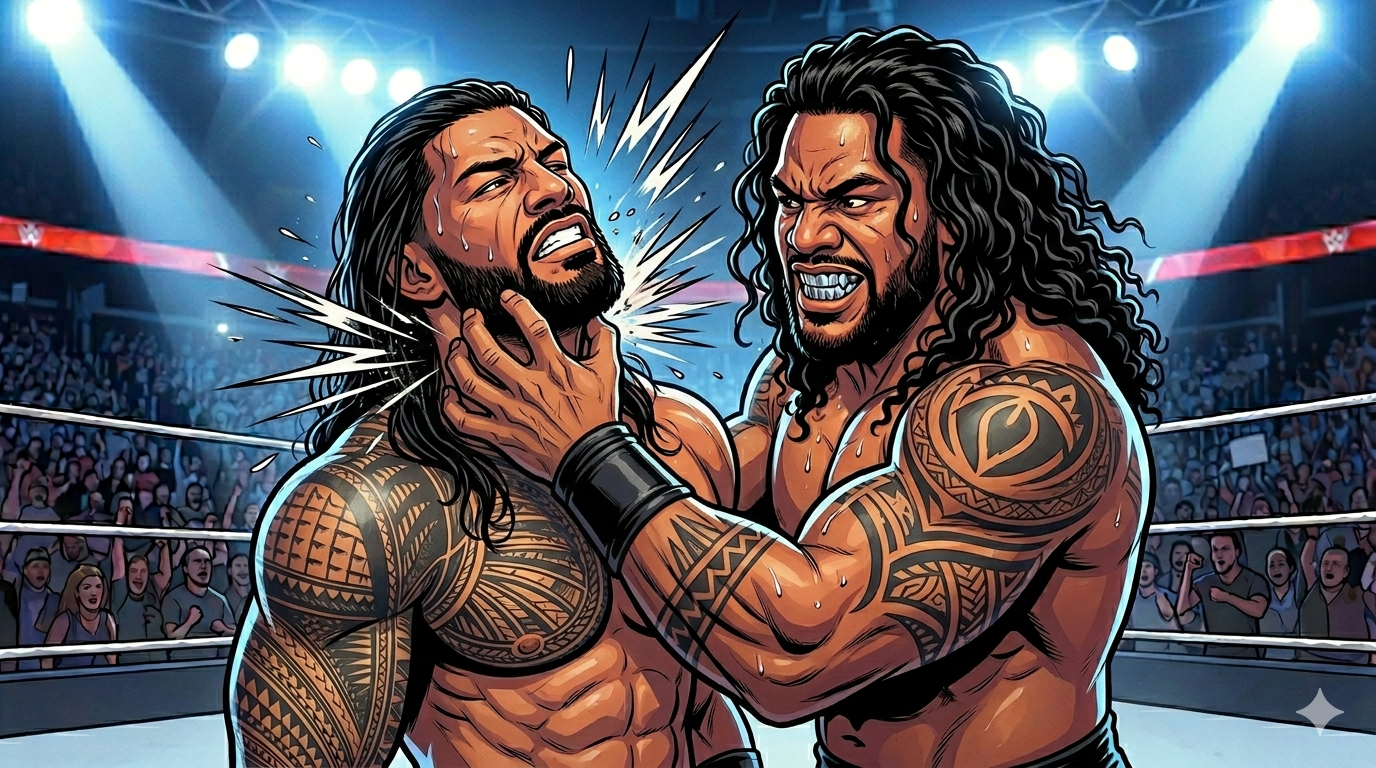
Alt Text: A high-intensity comic-book style illustration of Jacob Fatu applying the specific Tongan Death Grip to Roman Reigns' throat on WWE Raw, showing Fatu's new long hair and prominent silver teeth.

The dust has barely settled on WrestleMania 42, and while CM Punk and AJ Lee are taking some much-needed time off, the landscape of WWE has shifted violently. We saw CM Punk show up on the Raw after Mania, but his absence last night signaled the start of a new, grittier chapter: Roman Reigns vs. Jacob Fatu.

For those who have been following the journey, this move makes perfect sense. Jacob Fatu has been working tirelessly to be seen as a legitimate main-event player. We’ve seen him putting in the work, taking massive spots in the Cody Rhodes and Drew McIntyre saga, and holding his own within the Bloodline alongside Solo Sikoa.

Fatu is a beast in every sense of the word. He’s a big man who can pull off high-flying spots that defy physics, and his ability to recover from injury is almost superhuman. But what really anchors this character is the “recovered” storyline WWE is pushing—leaning into his real-life history, his time spent in prison at the age of 18, along with the motivation of providing for his family and seven kids. He’s a man who took the long road to get here, and that makes him dangerous.

The Grip of Death. On Monday Night Raw, we saw exactly how dangerous. Fatu used the Tongan Death Grip, made famous by Haku/Meng—not just a standard choke, but a brutal upward claw—to effectively paralyze and choke out the Tribal Chief.

It was a visual that changed the math for Backlash. Usually, we’d assume Roman Reigns wouldn’t drop the title only a month after winning it, but WWE has been playing by “weird” rules lately. To make Fatu believable as a World Champion, you have to actually treat him like one. They did it with Jey Uso, and it worked; doing it with a powerhouse like Jacob Fatu might just be the spark the Bloodline story needs to stay fresh.

I’m not saying Fatu is a lock to win at Backlash, but after seeing that grip and the fire in his eyes, I’m no longer betting against the Samoan Werewolf.

WrestleMania 42 Night 2: Shock Retirements, Logic Gaps, and the Death of the ‘Finisher’

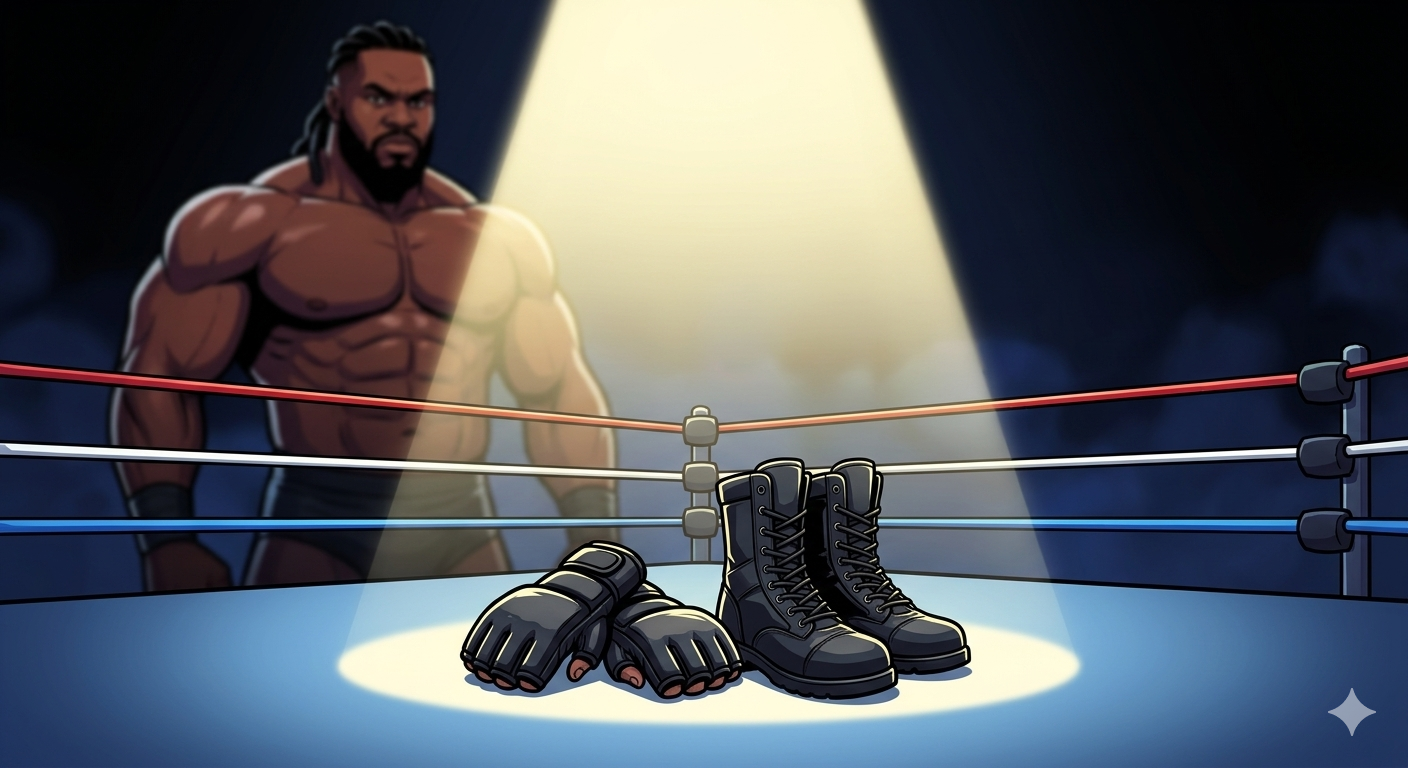
Alt Text: Cartoon illustration of Brock Lesnar's boots and gloves in the ring after his retirement match at WrestleMania 42.

Brock Lesnar Retires

If Night One was about “The Swerve,” Night Two was about “The Shock.” We saw an era end, a world title battle that bled buckets, and a few booking decisions that left me scratching my head. As someone who has been watching this “soap opera” since 1985, here is my unfiltered take on the final night of the Showcase of the Immortals.

The End of the Beast: Brock Lesnar’s Final Bow

The biggest shock of the night—and perhaps the decade—was Oba Femi beating Brock Lesnar in short order. In the business, we call this “putting someone over,” and it’s the ultimate courtesy a veteran can show on their way out.

Seeing Brock leave his boots and gloves in the middle of the ring was a “mint” moment. It makes sense why he’d lose quickly if he’s truly hanging them up. He gave Femi the “rub,” and while the match was just “okay,” the significance was massive.

Match of the Night: Rey Mysterio & Dragon Lee

For pure action, the tag match took the cake. Seeing Rey Mysterio and Dragon Lee combine to drive Rusev through a table was high-flying storytelling at its best.

I’ll admit, I was pulling for the underdog in the Intercontinental ladder match. Penta is great, but I wanted to see Javon Evans or JD McDonagh take that next step. JD, in particular, is a warrior—that back body drop into the ladder was absolutely brutal. He’ll get his moment, but it felt like a missed opportunity to crown a new face.

Where is the Logic? (The DQ Rant)

I have to talk about the Main Event: Roman Reigns vs. CM Punk.

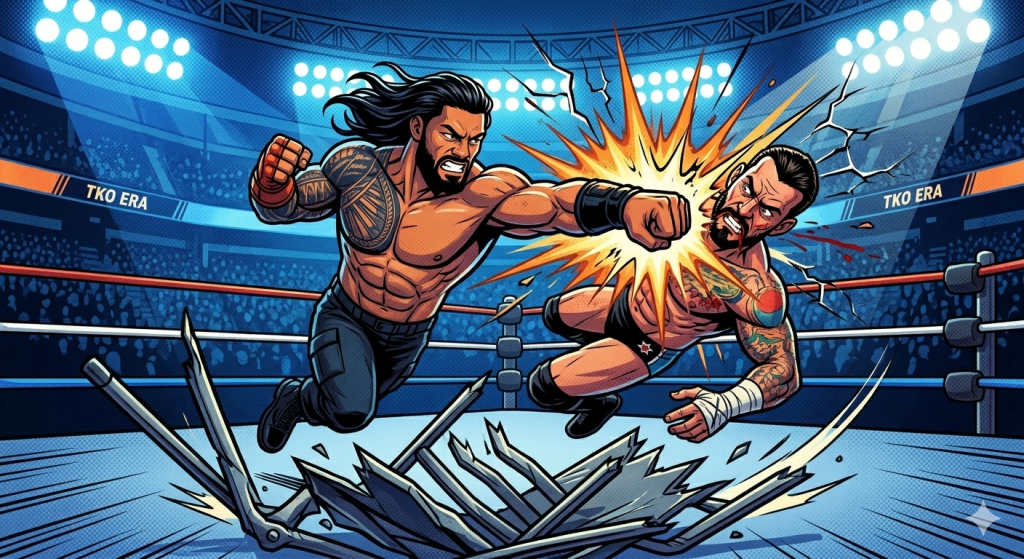
Cartoon illustration of Roman Reigns delivering a Superman Punch to CM Punk during their intense WrestleMania 42 main event.

This match had the time, the blood, and the storytelling it deserved. They traded finishers, they went through tables, and they beat the hell out of each other. But as an old-school fan, two things bothered me:

  1. The Chair Shot: Early in the match, Roman hit Punk with a chair. In a standard championship match, that’s a DQ. Period. Why did the ref just let it go? It takes me out of the story when the rules only apply when they’re convenient for the finish.
  2. The Death of the Finisher: We saw kick-out after kick-out. Back in the day, a finisher meant the end. Now, everyone kicks out of everything. It started with those legendary Taker vs. Shawn matches, but now it’s every match. If everyone kicks out of a Superman Punch or a GTS, those moves lose their power.

The Underwhelming and the Predictable

Sami Zayn vs. Trick Williams was, unfortunately, a letdown. Sami is a guy who almost ended Roman’s 1,316-day reign; he’s a top-tier underdog. Putting him in this spot felt like a step backward for a guy who should be in the main event picture.

On the flip side, Finn Balor and Dominik Mysterio delivered. “The Demon” never disappoints with the high spots, and that match lived up to the hype. Similarly, Rhea Ripley vs. Jade Cargill went exactly how we thought it would. Ripley is back on top, and it’s clear Jade has been working tirelessly on her in-ring skills—it showed.

Final Verdict: WrestleMania 42 Night Two was a rollercoaster of emotion and questionable logic. We said goodbye to a Beast, saw a title stay put, and reminded ourselves why we love (and occasionally hate) this business.


WrestleMania 42 Night 1: Splintered Tables, Triple Swerves, and the 1980s Sleeper Hold

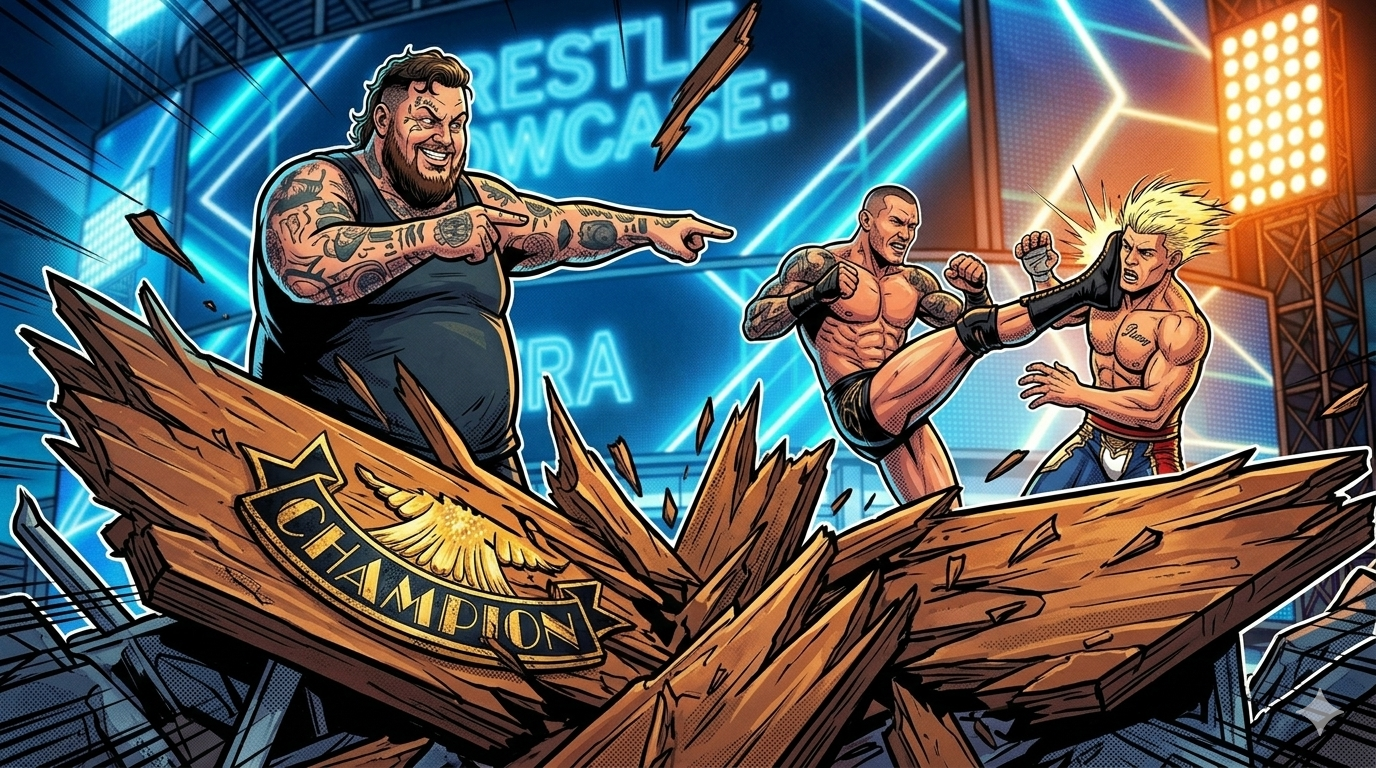
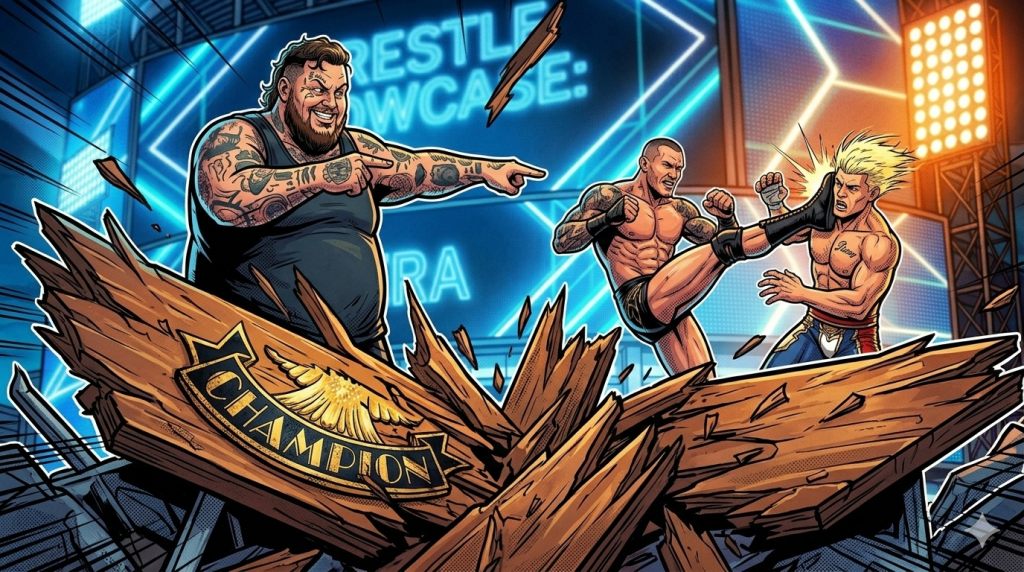
Cartoon illustration of the splintered wooden announce table after Jelly Roll's elbow, with Randy Orton punting Cody Rhodes in the background.

Night One of WrestleMania 42 is in the books, and it was a night defined by “okay” wrestling and some massive, unpredictable swerves. I watched it from the couch with a pizza, and honestly? That was the right call. Here is the “Meat and Potatoes” recap from a fan who has seen them all since 1985.

The Gunther Problem: A 1980s Finisher in a 2026 World

The Seth Rollins and Gunther match started exactly how I wanted: a brawl. It was physical and intense. But I have to push back on Gunther’s finisher.

Putting people to sleep with a sleeper hold feels like a mid-match transition move from the 80s. When you have a guy with a world-class Powerbomb in his arsenal, why are we ending WrestleMania matches with a sleeper? It slowed the momentum of a match that otherwise had a great “fight” feel.

Surprises in the Women’s Division

The Women’s Intercontinental match between AJ Lee and Becky Lynch was… okay. You could tell the timing was off in a few spots, which kept it from being a classic.

However, the Women’s Tag Team Championship was the surprise of the night. Seeing Paige return and win alongside Brie Bella was a genuine swerve that I didn’t see coming. It was a nice nod to the history of the division while actually giving us something fresh.

The Rise of Jacob Fatu

If you aren’t watching Jacob Fatu, start now. He beat Drew McIntyre in a match that proved he has more charisma in his pinky than most of the roster. WWE needs to push this man to the moon—he is a “mint” talent that actually feels dangerous.

The Main Event: The Jelly Roll Factor and the Triple Swerve

The build for Cody Rhodes vs. Randy Orton was heavily weighted down by the Pat McAfee angle. It felt like the office knew it, too. That’s why Jelly Roll took McAfee out early with an elbow through the table.

Side note: Did you see that announce table? Usually, they are “break-away” props you can put back together. This one shattered and splintered into actual pieces. I had to laugh—there was no “resetting” that one.

The match itself was Randy vs. Cody 101. Because the Vegas crowd was rooting so hard for Orton, Cody leaned into a heel persona for a bit. Then, the chaos:

  1. McAfee gets back involved.
  2. It looks like he’s helping Orton, but it turns into a disadvantage.
  3. Cody Rhodes picks up the win.

The internet is already melting down because Cody kept the title, but I’m here for the unpredictability. That double (or triple) swerve made me smile. And that Punt to the head from Orton after the bell? This feud is nowhere near over.

The Verdict: Night One had its flaws, but the main event delivered the drama. I’m officially hooked for Night Two.


Showcase of the Immortals? Why This 40-Year Fan Is Struggling to Care About WrestleMania 42

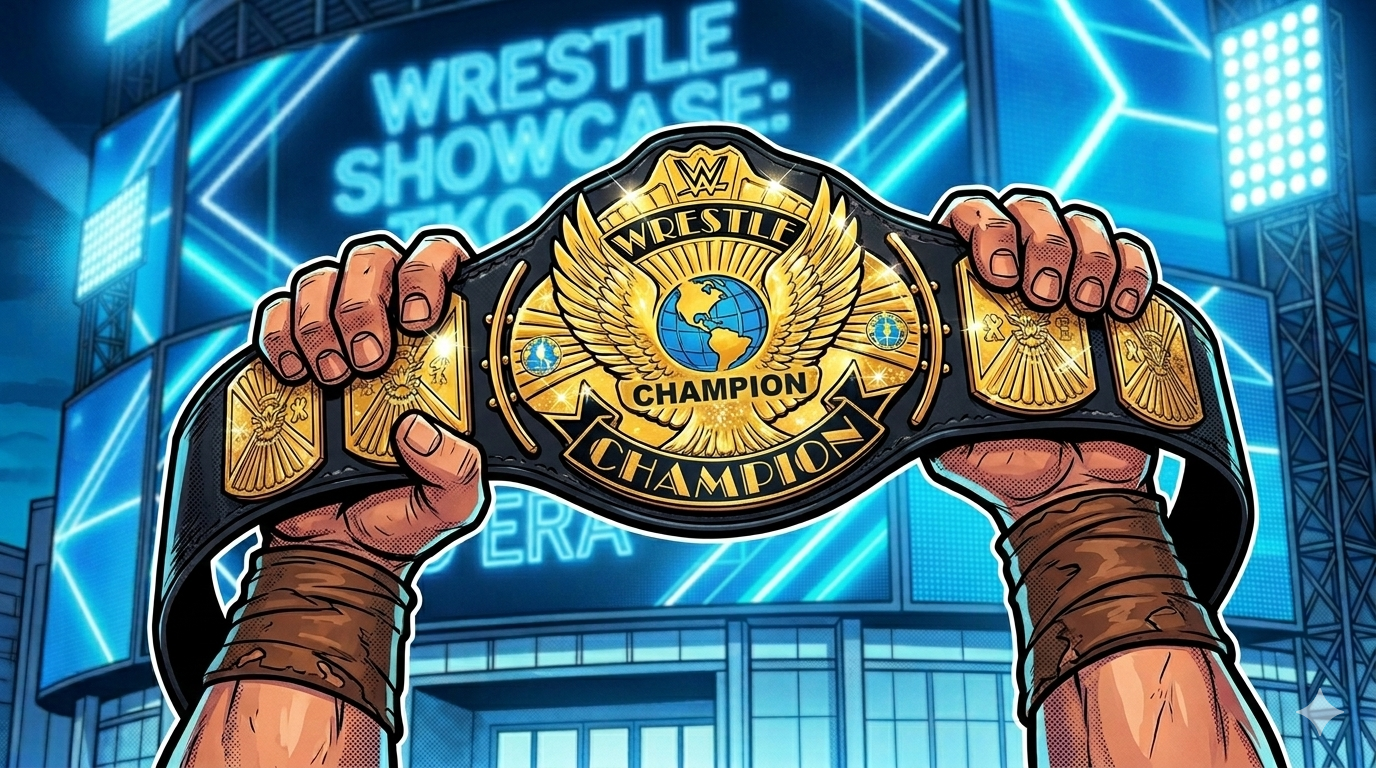
A closeup cartoon illustration of a fan with strong, leather-wrapped hands holding up a black-strap 'Winged Eagle' championship belt. A blurred modern 'TKO Era' stadium is in the background.

WrestleMania is here

By the time you read this, Night One is essentially minutes away. For 40 years, this has been coined the “Biggest Pay-Per-View,” the “Showcase of the Immortals,” and a plethora of other grandiose titles. It has defined generations.

I should be vibrating with excitement. I’m almost 44. I have been a wrestling fan since I was five. My relationship with this event is deep:

I remember WrestleMania 1 (1985), where Vince McMahon bet the farm that this supercard concept would become the Super Bowl of wrestling. He was right.

WrestleMania 3 is still notable to me because of the symbolic passing of the torch when Hulk Hogan slammed Andre the Giant.

I still own the VHS double-tape of WrestleMania 4 (1988).

It was a tournament to crown a new WWF Champion after “shenanigans” between Ted DiBiase and Andre left the title vacant.

Side note: Macho Man Randy Savage won that tournament, leaving with the ‘Winged Eagle’ belt. Even today, that is my favorite title belt of all time.

I could go on without straining my memory. I remember Shawn Michaels and Razor Ramon in the first ladder match at WrestleMania 10. I recall WrestleMania 12, where Millennials watched Shawn zip-line down before beating Bret Hart in an Iron Man match. WrestleMania 14 was Stone Cold’s moment against Michaels.

These aren’t just moments; they are straight memory anchors.

The State of Play in the TKO Era


I am bringing all this history up because, with WrestleMania 42 looming, I need to talk about the state of professional wrestling.

I am honestly not that excited to watch it.

The structure is exhausting. It is now a mandatory two-night event. We can’t organize our lives around it anymore; my friends and I essentially pick the lesser of two evils, watch one night together with pizza, and go our separate ways for the other. It feels less like an event and more like a task.

Since TKO bought WWE, the priorities have shifted. They seem more concerned with brand value than building logical arcs. We have weird booking, like Pat McAfee injecting himself into the already-awesome Cody Rhodes versus Randy Orton match. We have a strange clash between Seth Rollins and Gunther, a match that seemingly came out of nowhere.

This is where the story logic falls apart for me. We know Gunther was booked specifically to end the career of AJ Styles and John Cena. He is the career-killer.

If Seth Rollins—who is supposedly taking time away and dealing with drama with Paul Heyman—returns just to beat Gunther, it immediately makes Gunther beating Cena and Styles a moot point. It doesn’t make sense. But if Gunther wins, what was the point of Seth’s return?

Falling Out of Love with the Grind


I am not sitting here trying to be a cynical “armchair booker,” though I will say I would love to clean up this storytelling. I might also sound like a bitter, middle-aged millennial man yearning for the old days.

But the fact of the matter is that I do not know what I am watching anymore. And clearly, I’m not the only one. They are having trouble selling tickets to the point where Pat McAfee had to come on SmackDown last week to talk about discounts.

And that brings me to the meat and potatoes of this whole post.
The Real Solution: Support Your Local Indies

The current state of professional wrestling, and this includes AEW (which recently had an AEW show run five hours long on a day event, turning friends’ $70 tickets into $600 expenses for hotels and ferries just so they didn’t have to navigate from Vancouver back to Victoria), should force us to take an in-depth look into our local “Indie” promotions.

Most notably for me is Vancouver Island Pro Wrestling (VIPW). They do not have backhanded motives or streaming fees. There are countless others across the country doing fantastic work:

365 ProWrestling Vancouver Island

Here are some others from a quick search

BATTLEWAR (Montreal, QC): A very high-production, punk-rock vibe indie that sells out clubs and gets a lot of local press.

Smash Wrestling (Toronto, ON): One of the largest indies in Canada, they often feature talent that moves on to WWE/AEW.

Prairie Wrestling Alliance (PWA) (Calgary/Edmonton, AB): A historic indie promotion that keeps the Hart Dungeon tradition alive.


When you go local, you get people who are closely knit, doing it for the passion. They are fans like me who got an opportunity to learn how to wrestle, and they basically do it for a few bucks, maybe a hot dog, or some pizza. They are happy to be there.

They cannot throw ads in the middle of it. They won’t change camera angles on you in a chaotic way. They won’t all of a sudden surprise you with yet another streaming service fee. When you buy your ticket, you know right where that money is going: split evenly into the pockets of the entertainers and their help staff (mostly the wives, girlfriends, and friends that are happy to be there).

Why I Am Not Leaving the Legion
I am not here to crap on the profession. I know the people who entertain me for 20 bucks in the Legion hall have aspirations of making it to AEW or WWE one day, and that is a good thing. I love professional wrestling; it is my live-action soap opera.

But I am falling out of love with having to wade through ads, promotions, and backhanded motives. I just want to watch wrestling and enjoy it again.

Beyond the Burnout: The Violent Science of an NHRA Top Fuel Launch

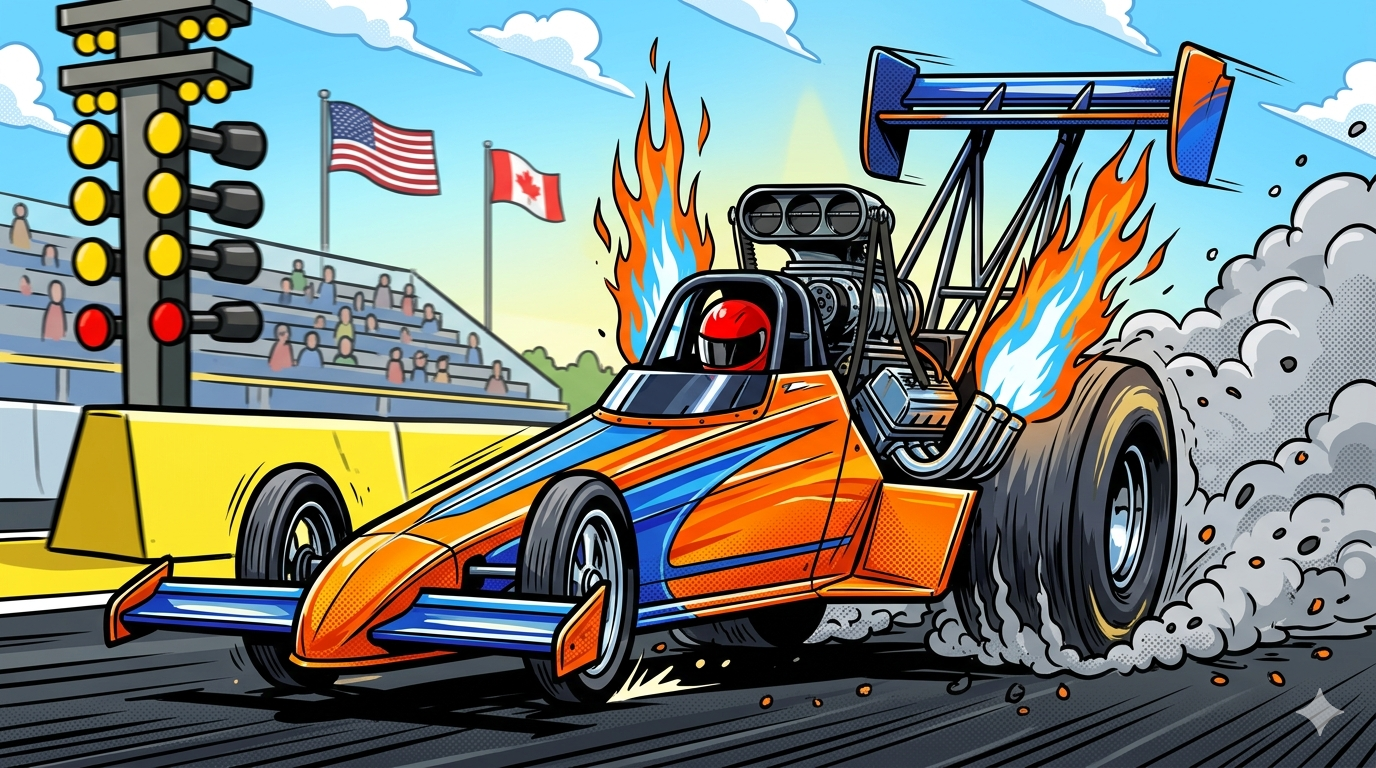
Cartoon illustration of an NHRA Top Fuel dragster launching from the starting line with header flames and smoke. (This is critical for web accessibility and indexing the image in search).

A NASCAR race lasts 500 miles. An NHRA Top Fuel race lasts approximately 3.6 seconds.

If you blink, you will miss the entire event. But in that handful of seconds, a nitro dragster does things to physics that shouldn’t be possible. If F1 is a surgeon’s scalpel, Top Fuel is a 12,000-horsepower sledgehammer with a rocket strapped to it.

When we talk about the most extreme motorsports on earth, this is it. Here is the lowdown on the violent, explosive science that happens every time a Top Fuel pilot hits the ‘Christmas Tree.’

12,000 Horsepower and the 8,000 RPM Burn

Let’s break down that number, because it’s hard to process.

A high-performance street car might have 500 horsepower. A semi-truck has maybe 600. An F-16 fighter jet engine generates roughly 29,000 pounds of thrust, which is equivalent to… a whole lot of horsepower.

A Top Fuel dragster does not use a transmission. The massive rear tires are direct-drive, connected straight to the supercharged, 500-cubic-inch Hemi engine. When the light turns green and the clutch seals, all 12,000 horsepower hits the track at once.

The engine doesn’t just ‘run’; it is essentially a controlled explosion. The fuel pump delivers 100 gallons per minute of nitromethane—the same explosive mixture used in professional demolition—directly into the cylinders at over 8,000 RPM. This fuel is so volatile that the engine is built to run for less than three minutes total, including the warmup and burnout, before it needs to be completely rebuilt.

The Science of ‘Hooking Up’

It’s not about how fast the engine spins; it’s about how that energy translates to motion. A Top Fuel car will hit 100 MPH in less than 0.8 seconds. This requires a level of traction that standard tires cannot come close to providing.

This is why Top Fuel tires (the ‘slicks’) are so massive, and why they wrinkle during launch. The tire is designed to flex and stretch, essentially becoming an extendable paddle that claws at the specially treated ‘sticky’ tarmac track surface. The goal isn’t ‘spinning’ the tires; it is getting the soft rubber to fuse with the track at molecular levels. If the tires lose traction (called ‘smoking the tires’), the engine can instantly over-rev and violently explode. It is a terrifying high-wire act.

Physics vs. the Driver

The experience in the cockpit is brutal. A driver launching a Top Fuel dragster pulls 4 to 5 Gs—more than a fighter pilot or a space shuttle launch. The acceleration is so intense that the driver’s vision may momentarily blur, and they must hold their breath because the force makes it impossible to inhale.

But the real threat isn’t just G-force; it’s the vertical force. The dragster is designed to lift the front wheels off the ground to transfer all weight to the rear tires. The driver is fighting to keep a 300-MPH, nitro-burning beast in a straight line, while essentially riding a vertical wheelie.

The Gretzky Standard: Why There Is Still No True Hockey GOAT Debate

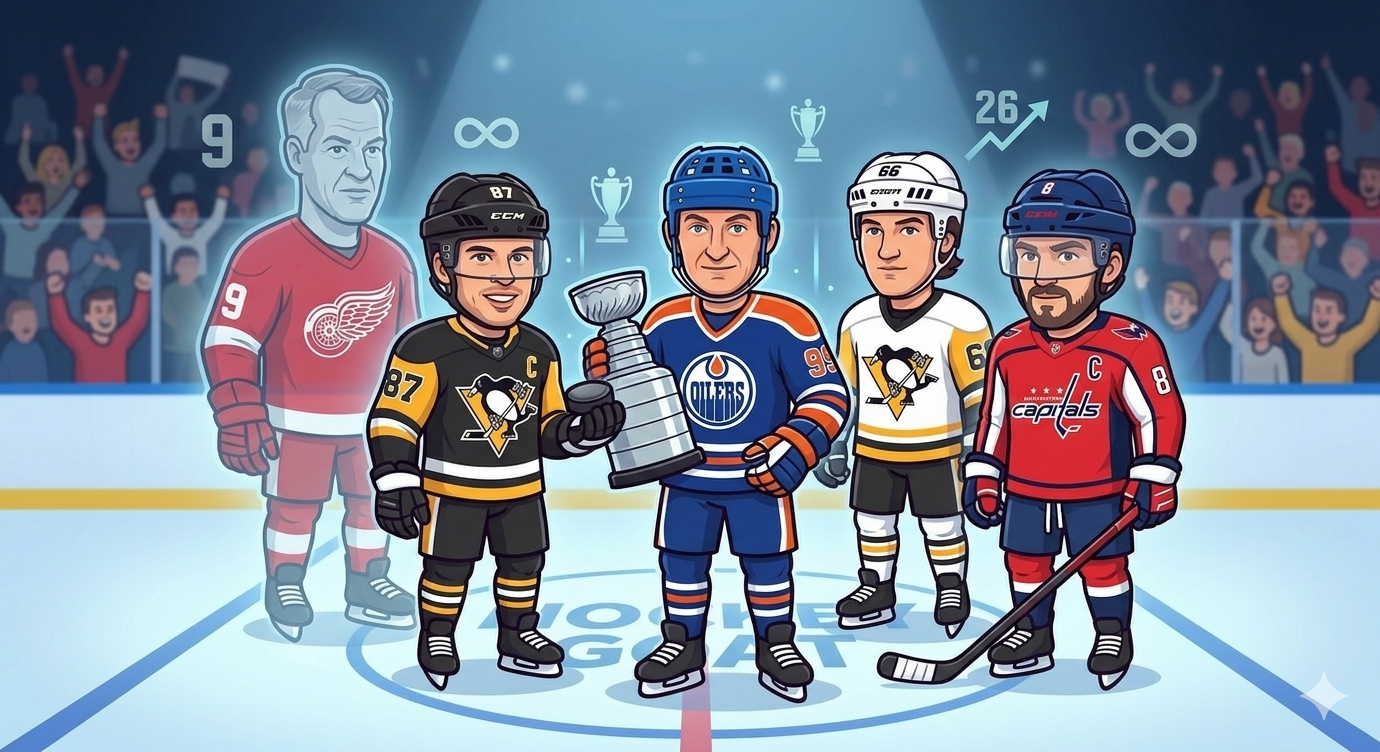
A cartoon illustration of five hockey legends in their NHL uniforms—Wayne Gretzky, Sidney Crosby, Alexander Ovechkin, Mario Lemieux, and Gordie Howe—standing on a hockey GOAT blue line, debating the greatest hockey player of all time.

Hockey fans love to argue. But when it comes to the “Greatest of All Time,” we are usually arguing over numbers 2 through 5. Because when you look at Wayne Gretzky, you aren’t just looking at records; you are looking at a mathematical anomaly.

You can launch a sportswriter.ca hockey category, but you cannot hide from “The Great One.”

My Professional Opinion: The “Big Five” You absolutely should include Gordie Howe, Mario Lemieux, and (as of 2026) Alexander Ovechkin in the conversation. Sidney Crosby, of course, must be there. Here is how that “Big Five” maps out:

  1. Wayne Gretzky (The Standard): It’s not close. He has more assists (1,963) than anyone else has points. If he had scored zero goals, he would still be the NHL’s all-time leading scorer. That isn’t a career; that’s a glitch in the matrix.
  2. Gordie Howe (The Foundation): He is the origin story. Before Gretzky, there was “Mr. Hockey.” He defined the blend of brute force and elite skill, setting the original “unbreakable” record (801 goals).
  3. Mario Lemieux (The Talent): He is the single greatest pure talent the NHL has ever seen. His point-per-game average is essentially identical to Gretzky’s. If he hadn’t missed significant parts of five seasons, we might have been looking at a true 1a/1b.
  4. Alexander Ovechkin (The Pure Scorer): You can’t talk about GOATs in 2026 without acknowledging the greatest shot the world has ever seen. Ovi did one thing better than anyone else: find the back of the net. That focus is his legacy.
  5. Sidney Crosby (The Mind): Sid is the anti-Ovechkin. He is the ultimate hockey mind, a player who reinvented his game multiple times. He has won everything possible, and he controls the ice with intelligence, not speed.

The Verdict: Numbers and Intelligence Sidney Crosby is the best cerebral hockey player since Gretzky. He has the 1,500+ points, the three Cups, and the 20 years of relentless intelligence. If we are judging who played the game “smartest,” Crosby is in the argument.

But hockey is about points, and Gretzky’s numbers are a fortress. My take for sportswriter.ca: The true hockey debate isn’t “Who is better than Gretzky?” The true hockey debate is “Who is the most complete player after Gretzky?”


The Talladega Reality Check: Why NASCAR Was Right to Say ‘No’ to Cleetus McFarland

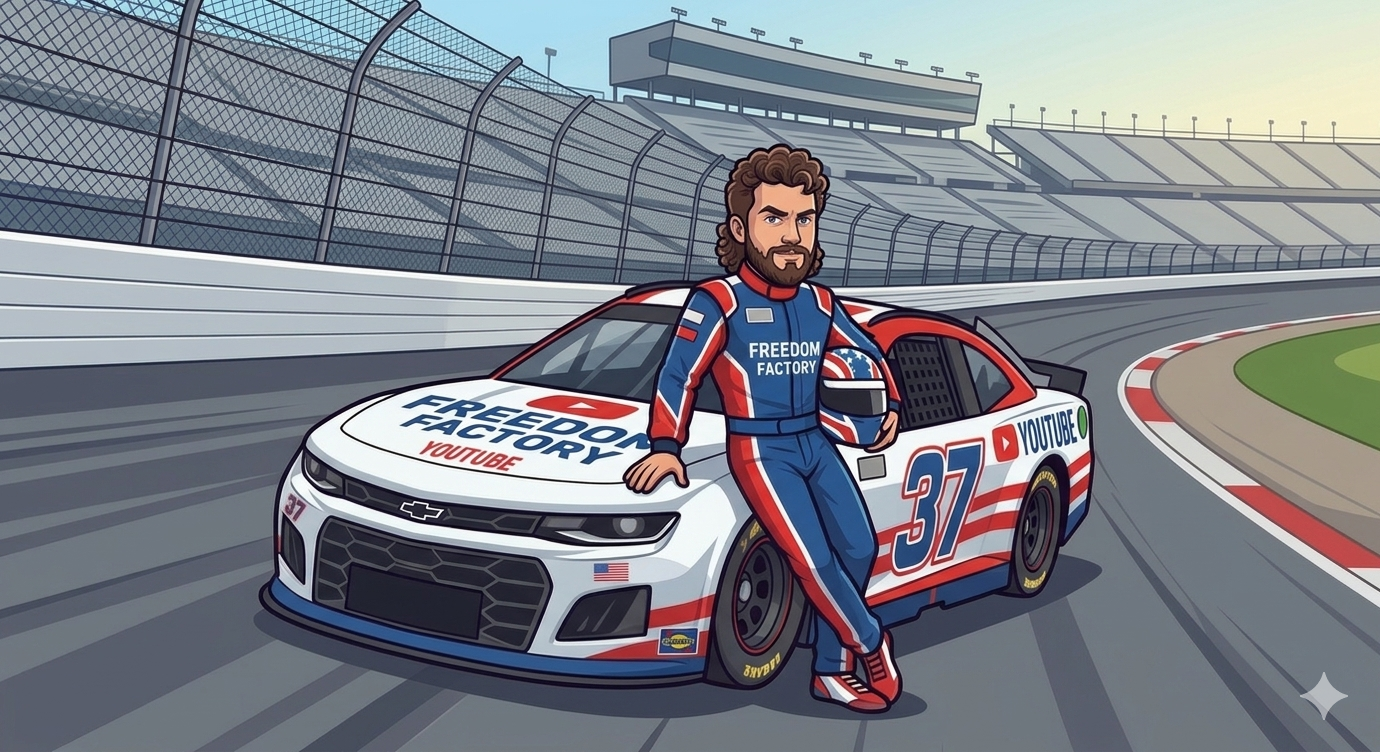
A cartoon illustration of Cleetus McFarland in his patriotic red, white, and blue racing suit at Talladega Superspeedway, leaning on a stylized stock car with 'FREEDOM FACTORY' and 'YOUTUBE' generic sponsors, after NASCAR did not clear him to race.

We all love Cleetus McFarland. (Real Name Lawrence Garrett Mitchell) The guy is a content machine. If you are a fan of burning rubber, crazy builds, and sheer automotive spectacle, his YouTube channel is a must-watch. He’s done drifting, legendary Crown Victoria pay-per-views during COVID with other personalities, and of course, he bought and resurrected the old DeSoto Speedway, now known as the “Freedom Factory.” He builds trucks, does giveaways, and recently has been getting deep into circle-track racing.

He’s a passionate, skilled drag racer, but when he set his sights on the NASCAR ARCA series at Talladega—one of the fastest, most dangerous superspeedways in the world—NASCAR made the tough decision not to clear him. And you know what? They were absolutely right.

The G-Force Reality Now, I know what you’re thinking: “Who are you, sitting on your couch, to say Cleetus can’t handle it?” That’s a fair point. I’ve never driven a stock car. But I do know this: NASCAR drivers are elite athletes. Legends like Richard Petty didn’t retire because they lost their touch; they retired because their bodies could no longer keep up with the physical demand.

Driving at Talladega isn’t just “turning left.” It’s sustaining 200 mph while pulled by intense G-forces for hours, all while being inches away from other massive cars. If you don’t have enough “seat time” in that specific environment at that extreme speed, it is a recipe for disaster—for you, and for everyone else on the track.

The Seat-Time Factor Cleetus is a legend on the drag strip, but superspeedway racing is its own beast. He has crashed before (he had a big moment in an ARCA race at Daytona a couple of years ago), and while he is learning fast, experience matters most at a track like ‘Dega. You cannot “content generate” your way into knowing how to handle 200 mph G-forces and a 40-car pack.

I love Cleetus’s hustle, but NASCAR prioritized safety here. It was a reality check the “Creator Economy” needed. He needs more time in the seat before taking on the big leagues.


The Greatest Heel Turn in Wrestling History (Part 1)

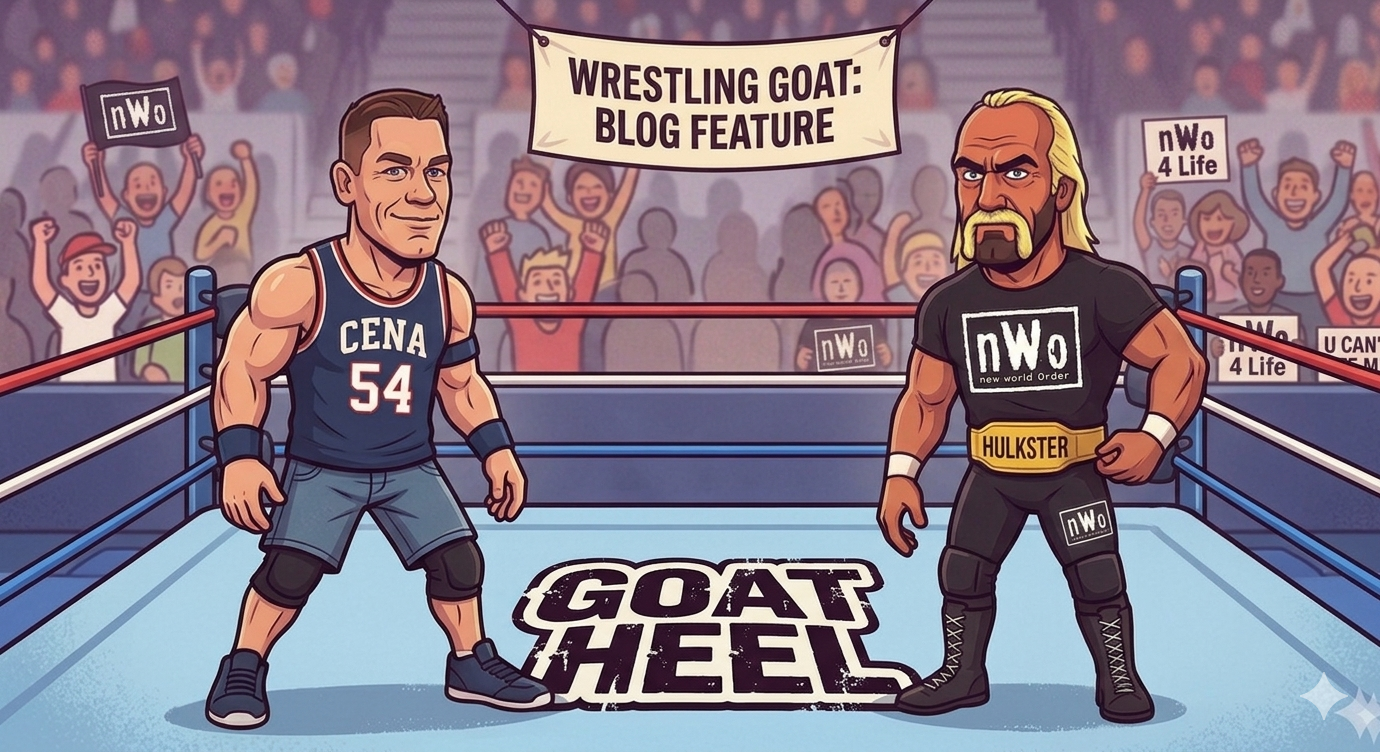
A cartoon illustration of wrestlers John Cena in his number 54 jersey and Hulk Hogan in his black "nWo" gear, standing face-to-face in a wrestling ring labeled "GOAT HEEL".

Was John Cena’s Heel Turn more shocking than Hulk Hogan’s?

Welcome to Sportswriter.ca. Let’s get straight to the point: the greatest trick the devil ever pulled wasn’t convincing the world he didn’t exist—it was John Cena convincing the world he would never, ever turn heel.

For decades, the gold standard for the “shocking betrayal” was July 7, 1996. We all remember Hulk Hogan dropping the leg at Bash at the Beach and the “torrents of garbage” that followed. It was a seismic shift that launched the nWo and birthed a more adult-oriented era of wrestling. But I’m here to argue that John Cena’s 2025 turn at Elimination Chamber was a more impressive achievement.

The biggest difference? The era of the spoiler.

In 1996, the “dirt sheets” existed, but they didn’t have the instantaneous reach of a global social media landscape. In 2025, every fan in the arena is a reporter with a camera and an X (Twitter) account. Keeping a secret for twenty minutes in the modern age is hard enough—keeping a secret that the “ultimate babyface” was finally going to snap after twenty years of corporate resistance is nearly impossible.

Hogan’s turn was reactive; he was becoming “aging and stale” and needed to hitch his wagon to the “cool” Outsiders to stay relevant. Cena, however, turned while still being the company’s most protected brand ambassador. Even though the turn didn’t last as long as the nWo, the sheer difficulty of pulling it off without a single leak makes it, in my opinion, an even more impressive feat of storytelling.

This is the first in a series of posts where I’ll be dissecting the “unseen impact” of Cena’s dark turn. We’re going to look at the numbers, the fan psychology, and why being “predictable” for two decades made the eventual surprise the most impactful moment in history.

Stay tuned. The tag might be in the wrong place, but the analysis is exactly where it needs to be.

Part 2: The LeBron James Respect Factor

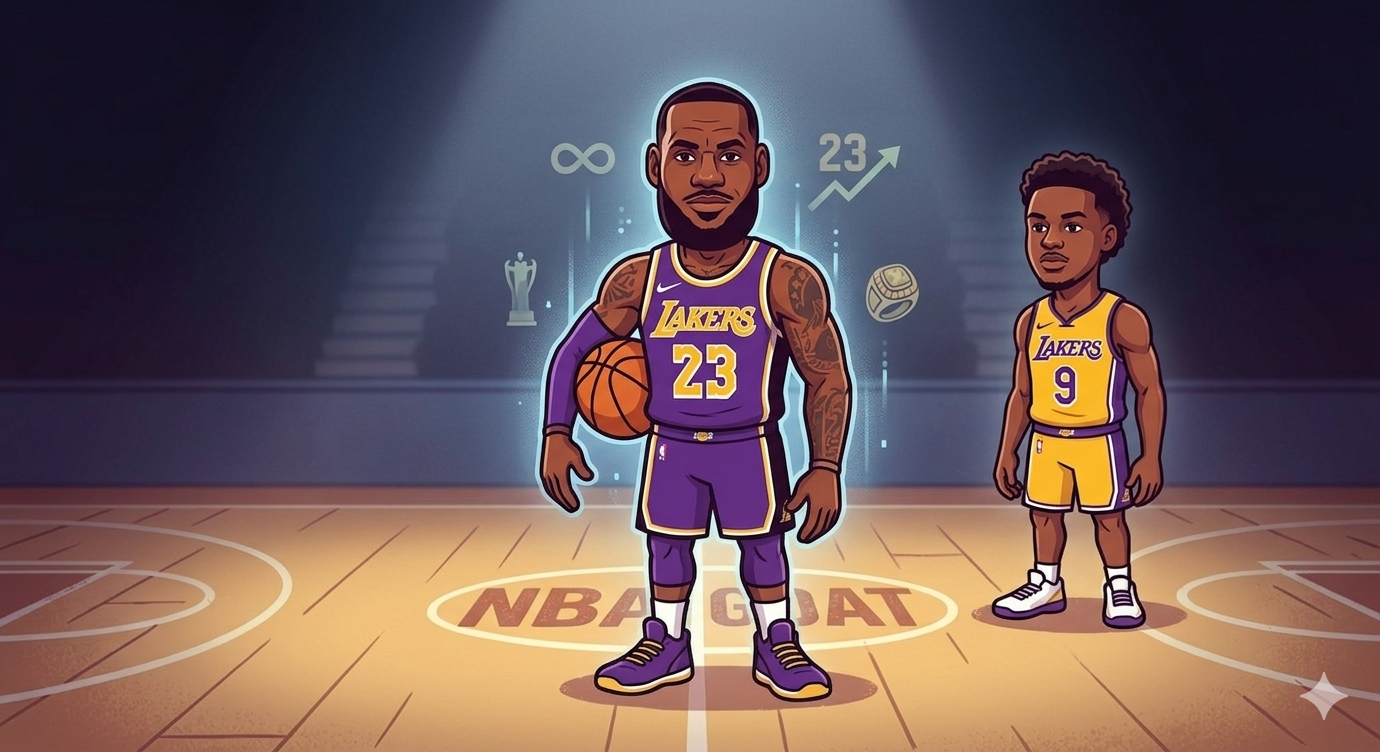
A cartoon illustration of LeBron James (Lakers #23) holding a basketball on the NBA GOAT court, surrounded by floating statistical symbols representing his 23-season longevity, with Bronny James (Lakers #9) standing in the background.

The Longevity of Greatness: Why LeBron Needs More Credit

While we fight for Kobe’s seat at the table, we have to address the “King” in the room. LeBron James is currently playing in his 23rd NBA season. Think about that for a second. Most players are lucky to make it to season 10.

The Routine and the Stats People throw big-time shade at LeBron. They point to his Finals record or his “superteam” moves. But what they ignore is the sheer professionalism it takes to stay at this level for two decades. LeBron’s stats are better because he’s played longer, but that’s not a fluke—it’s the result of a legendary routine and a commitment to his body that we’ve never seen before.

The Genuine Side of the King Beyond the triple-doubles, LeBron seems like a genuine person who understands the weight of his platform. Watching him play alongside his son, Bronny, in 2026 is one of the coolest full-circle moments in sports history. It’s not just a PR stunt; it’s a testament to his longevity and his role as a father.

The Verdict MJ had the peak. Kobe had the mentality. LeBron has the career. You don’t have to hate one to love the other. But next time you’re debating the GOAT, don’t just stop at 23 and 6. Remember the 24. Remember the 81-point night. And remember that the conversation is a lot more crowded than people want to admit.


Who is your #1? MJ’s rings? Kobe’s Mamba Mentality? Or LeBron’s endless prime?

Send your arguments to scout@sportswriter.ca—we’re looking for the best fan takes to publish in our “Reader’s Voice” column next week!